
Top Signs You Need Air Duct Cleaning Service – Don’t Ignore These
The most common mistake we see is treating every dust or smell complaint as a call for duct cleaning. It usually isn’t that simple. Register dust usually means your filter is letting particles through. A musty smell means something is growing somewhere specific. Rising bills point to leaks, not dirt. Before you book anything, read what each sign actually tells you – and if you’d rather have a trained eye look at it, call (833) 509-3460.
Dust on Supply Registers vs. Dirt Inside the Ducts
Dust collecting on supply registers is not proof your ducts are dirty. It’s proof your filter isn’t catching particles before they reach the duct surface. Clean the ducts without fixing the filtration and the same dust pattern comes back within weeks.
Here’s how to tell the two problems apart at home:
- Register face only: a gray film on the grille that wipes off easily usually means filter bypass. The register is the last thing air touches, so it catches whatever the filter missed.
- Debris visible inside the boot: if you pull the grille and see a mat of lint or dust on the metal just past the opening, contamination has reached the duct interior.
- Debris blowing out at the register: particles leaving a supply register under normal airflow mean loose material is sitting close enough to the outlet to be carried.
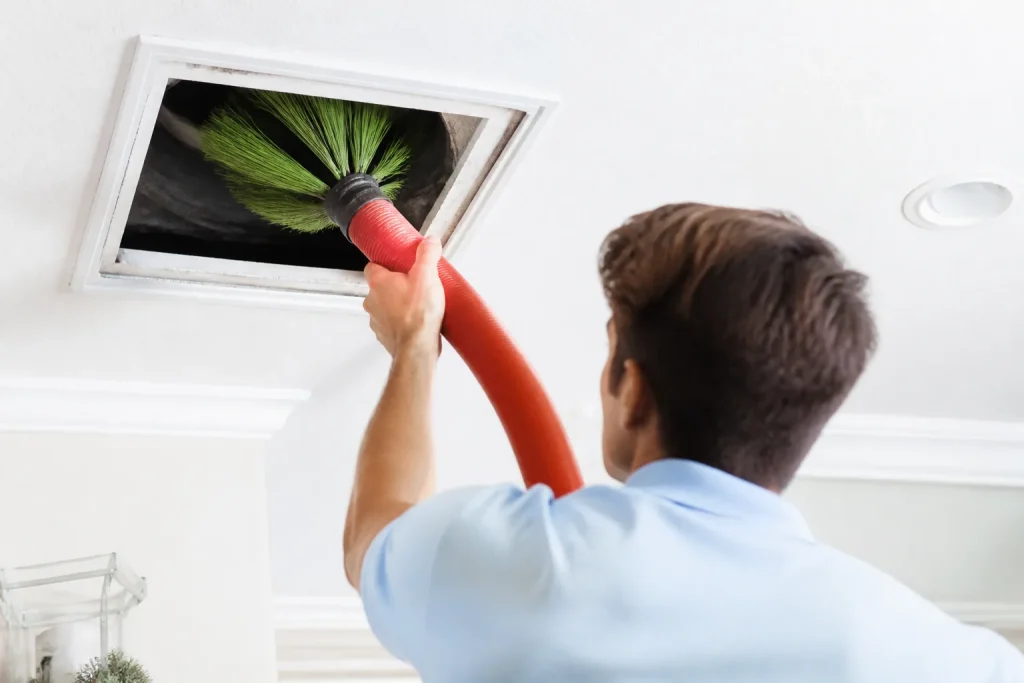
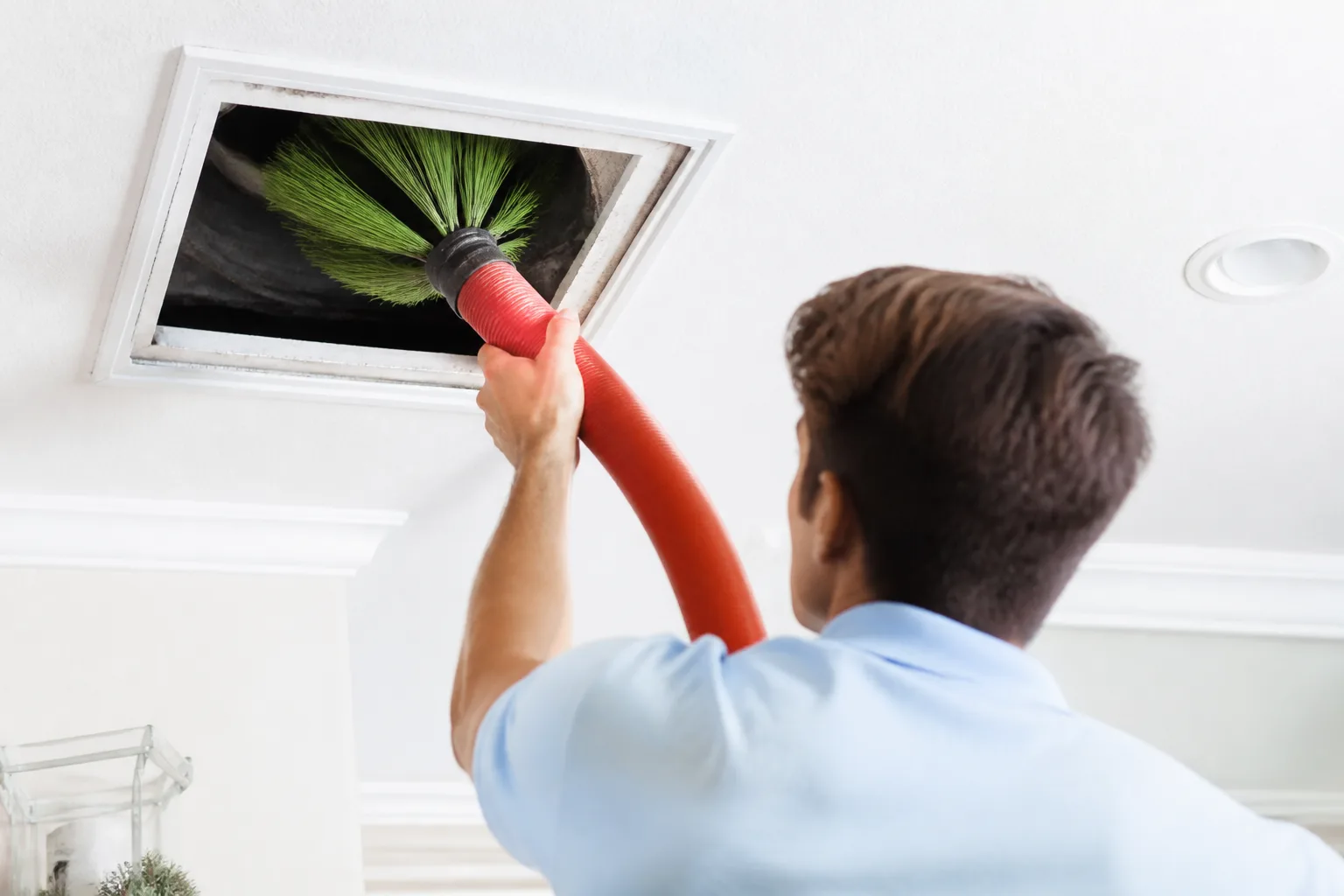
We use Rotobrush contact cleaning for the second and third cases, because the method physically agitates the duct wall rather than pushing air through it. For the first case, the honest fix is a filter upgrade and a check for gaps around the filter slot. Cleaning alone won’t hold. If you’re in Brier Creek and aren’t sure which case you’re looking at, that’s a fair reason to call before spending anything.
What a Musty Odor at the Vents Actually Tells You
A musty smell at the vents means biological growth is present somewhere in the air pathway – but the location decides the remedy. Three spots account for nearly all of it, and each looks different from the one before it.
- The air handler coil. The coil stays damp when drainage is poor or the system short-cycles. Smell is strongest when the fan first starts and fades as air moves.
- Duct liner. Insulated flex duct and internal liner hold moisture against a porous surface. The smell is steady and stronger at registers in humid rooms, like bathrooms and basements.
- Duct interior surface. Dust that stayed damp becomes a food source. You’ll usually notice this smell in more than one room and it doesn’t clear when the system runs.
This is why we treat odor as a diagnostic question, not a cleaning order. A coil problem needs the coil cleaned and drainage corrected. A liner problem sometimes means replacing the run. A contaminated duct interior is a cleaning and sanitizing job. Our air quality and sanitizing work uses Abatement Technologies filtration equipment, which brings air-purification-grade filtration into a residential system instead of a shop vac. Call (833) 509-3460 if the smell has been there more than a couple of weeks.
Debris From Supply Registers vs. Return Registers
Which registers are pushing debris tells you where the contamination sits. Supply registers deliver conditioned air into rooms. Returns pull air back to the air handler. Debris exiting a supply means the contamination is upstream of that outlet and close to it. Debris appearing at returns is a different story: it usually means the return side is pulling from a dirty space – an open basement, a garage-adjacent chase, or a return grille sitting near a litter box.
Pay attention to the pattern:
- One supply, one room: a localized problem in that branch run, often a failed joint or a torn liner.
- Several supplies on one side of the house: a trunk line issue or a disconnected run dumping into a wall cavity.
- Returns only: filtration and source control first. The return is doing its job, just with dirty air.
Localized debris is also the single best argument for duct repair and sealing. Seal the leaks, not just clean the ducts, and you stop new material from being drawn in through gaps in the first place. That’s part of the full-system approach we take on every job in Brier Creek, and it’s the step that keeps a cleaning from becoming a recurring expense.
Allergy Flare-Ups in One Room and Not Another
A sudden allergy flare-up confined to one part of the house points to a localized duct problem, not whole-system contamination. Whole-house contamination produces whole-house symptoms. One bedroom, one office, one basement corner is a branch-level question, and it’s worth diagnosing before you pay to clean runs that aren’t the issue.
What localized symptoms usually trace back to:
- A disconnected or crushed flex run feeding that room, which pulls air from a crawlspace or wall cavity.
- A return path that was never properly connected, so the room runs at positive pressure and pushes dust out of every seam.
- Moisture in that branch only, often from a bathroom exhaust ducted into the wrong place.
We’ve seen rooms where the whole complaint came down to a single joint that had pulled apart behind the drywall. That’s a repair, not a cleaning. Our technicians have up to 12 years of experience reading these patterns, and the first step is always to figure out which branch is responsible before touching the rest of the system.
When to call a pro: if symptoms persist after a filter change and a vent wipe-down, or if you can see a gap or torn liner at any register, it’s worth having it looked at. Creeping into a crawlspace or attic to chase a duct run yourself is a good way to find out exactly how much insulation itches.
The Post-Renovation Timeline Most People Get Wrong
After drywall work, cleaning should happen within 60 to 90 days – not at the next scheduled interval. Drywall dust is fine, abrasive, and it settles into duct interiors where a household vacuum can’t reach. Wait a year and it has coated the duct walls and, in many homes, the blower wheel.
Why the window matters:
- Weeks 1 to 4: dust is still loose and easy to extract. This is the cleanest opportunity you’ll get.
- Weeks 4 to 12: dust begins to compact against the duct wall. Contact cleaning still lifts it, but it takes more passes.
- Beyond 90 days: the system has circulated that dust through every room for a full season, and it’s now sitting on coils and blower fins too.
Renovation debris also includes bits of trim, insulation, and drywall paper that can block a run outright. We use Nikro professional extraction equipment, the same class of tooling used by commercial restoration contractors, because residential vacuums lose suction the moment they meet construction dust. If you’ve just finished a kitchen or a basement in Brier Creek, this is the one timeline worth putting on the calendar.
Related services in Brier Creek
If any of the signs above match what you’re seeing, we handle the full pathway: air duct cleaning, dryer vent cleaning, and HVAC cleaning, along with duct repair and sealing. For the full picture of what we do, start at Air Duct Cleaning Brier Creek.
What happens when you call
- 1
A real person answersNo phone trees – you reach a local pro.
- 2
You get an upfront price rangeHonest numbers before anyone is dispatched.
- 3
A background-checked tech heads outLicensed & insured, dispatched right away.
- 4
You approve before work beginsNothing starts until you say go.
The Bottom Line
Dust on the register, a musty smell, and a rising bill are three different messages. Dust usually means filtration. Smell means moisture and growth, in a specific place. A high bill means air is escaping through leaks that cleaning can’t close. Getting the diagnosis right is the whole job – cleaning the wrong thing costs money and solves nothing.
Key takeaways:
- Register dust is a filter problem first, a duct problem second.
- Musty odor location determines whether you need a coil cleaning, a liner replacement, or sanitizing.
- Debris at one supply register means a localized branch issue.
- Post-renovation cleaning belongs on a 60 to 90 day timeline.
- Seal the leaks, not just clean the ducts.
If you’re in Brier Creek and need help, Air Duct Cleaning Brier Creek offers free estimates – call (833) 509-3460. We answer 24/7. Fast dispatch from 7am to 7pm, Sunday through Friday.
Frequently Asked Questions
Most homes don’t need it on a fixed schedule. A reasonable interval is every three to five years, sooner after renovation, a move-in, or any water event that reached the ductwork. Homes with pets or heavy seasonal pollen loads often fall on the shorter end. Call (833) 509-3460 for an exact assessment – estimates are free.
Ask for before-and-after photos of your own duct interiors taken through the access points. A crew running Rotobrush contact cleaning and Nikro extraction should be able to show the duct wall before and after. If a company can’t document it, that’s your answer. Call (833) 509-3460 to book an estimate.
Cheap quotes usually mean a per-vent price with no trunk line work, or a vacuum passed over the registers without touching the duct walls. The number looks great until the invoice grows on site. We price per system, agreed in writing before work starts, so the number you hear is the number you pay. Call (833) 509-3460 for a written estimate.
It depends on the number of systems, the length of the runs, and whether sealing or sanitizing is part of the job. We set one flat price per system after seeing the layout, and the written estimate is the final price. Call (833) 509-3460 – estimates are free.
Written by the team at Air Duct Cleaning Brier Creek.
Need Air Duct Cleaning Help?
Call Air Duct Cleaning Brier Creek - the local pro we connect you with is licensed and insured, here with fast help in Brier Creek.
(833) 509-3460